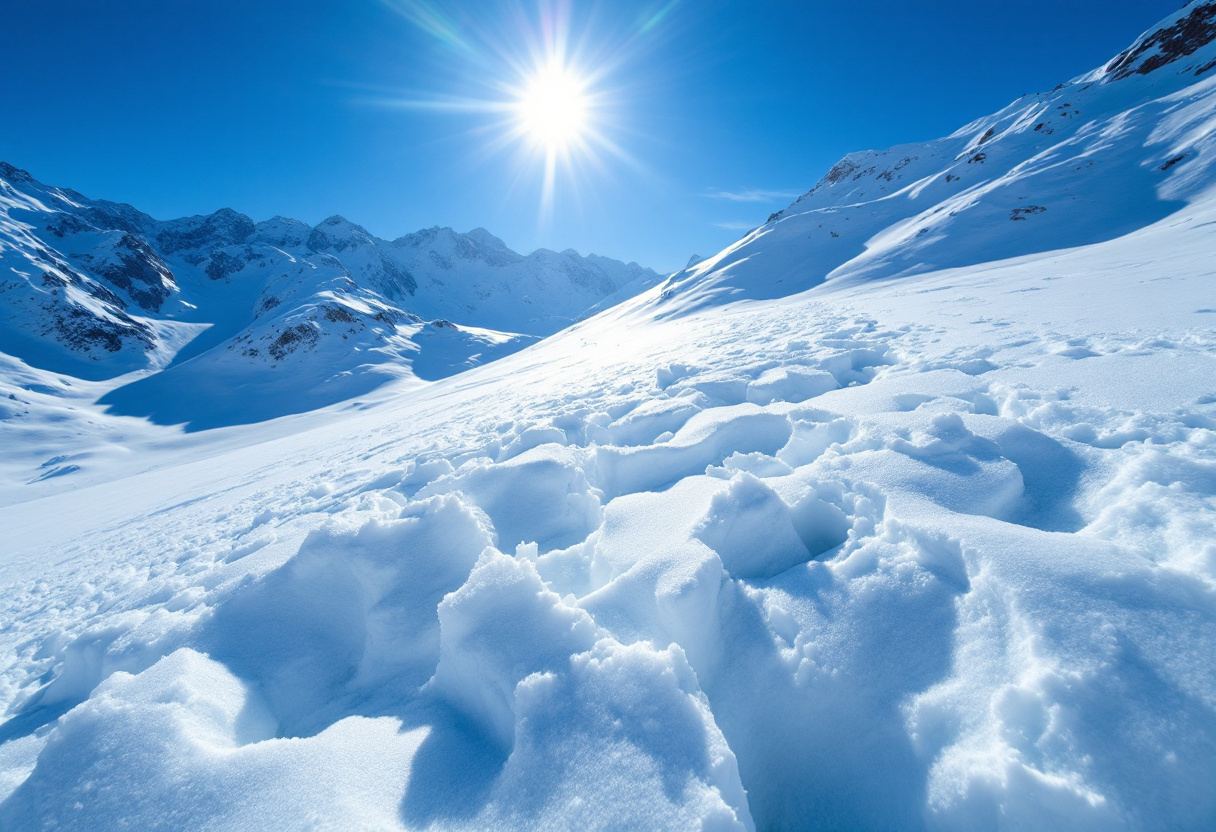
If you want to understand why the word "waterproof" is a problem, spend a spring day ski touring. Everything that makes sun protection difficult is present at once: an environment that increases the dose, a surface that reflects it back at you from below, cold air that removes every warning sign, a full day of duration, and a set of textiles rubbing your face for ten hours.
Snow is also where the consequences are most visible. Skiers and tourers burn under the nose, under the chin, on the eyelids and inside the nostrils. Those are not places the sun reaches on a normal day. They are places that reflected ultraviolet reaches.
The conditions, set out plainly
A spring ski tour, above the treeline
Conditions block- UV load
- Very high to extreme in spring conditions at altitude. Two effects compound: ultraviolet rising with altitude, and reflection from fresh snow, which the World Health Organization describes as a strong reflector of ultraviolet.
- Water exposure
- Low as liquid, but melting snow, spindrift and a wet buff all remove film.
- Sweat
- Very high on the ascent under a shell, and instantly hidden by cold air.
- Friction
- High from a buff, a helmet strap, goggle foam and repeated wiping.
- Typical duration
- Six to twelve hours, starting before dawn and finishing in full sun.
- What fails first
- The film under the nose and chin, removed by a buff and by wiping, in the exact places taking reflected ultraviolet.
- Protection strategy
- Total facial coverage including the underside of the nose and chin, category rated eyewear worn from first light, lip protection with a sun protection factor, and reapplication at every transition. Textile everywhere it is possible.
Reflection is the whole story
The World Health Organization's material on ultraviolet describes fresh snow as a strong reflector, substantially higher than sand or water. That means a tourer above the treeline is standing in the middle of a large, bright reflector, receiving ultraviolet on surfaces that have no natural exposure and therefore no adaptation and no habit of protection.
Two consequences follow. First, application has to be genuinely complete: under the nose, under the chin, the ears including behind them, the eyelids as far as is comfortable, and the lips. Second, eye protection is not cosmetic. Photokeratitis, sometimes called snow blindness, is a real and painful ultraviolet injury to the surface of the eye, and it is preventable with eyewear that meets the relevant standard. Our note on eyes and lips explains what the categories mean.
Cold removes the warning
Every intuition people have about sun exposure is built on heat. Snow removes it completely. It is entirely possible to be cold, in a shell, with a buff over your face, acquiring a serious burn. This is why ski sunburn is so often severe: nothing tells the person to stop, and by the time it announces itself, the day is over.
The reapplication clock
Reapplication clock: A spring tour, skins on at 0500, back at 1500
The unusual feature of snow is that the loss and the exposure both peak at the same time. Mechanism only.
The buff problem
A buff or face covering is excellent protection while it is up and covering. The difficulty is that it moves, it gets wet with breath and condensation, it freezes, and every time it is pulled up or down it wipes the film off the skin underneath. Tourers end up with a sharp burn line along the top of where the buff sat, and thinned protection on the cheeks.
The practical answer is to treat the buff as a mechanical removal event, not as protection, and to reapply the face whenever it has been up and down repeatedly. Alternatively, keep it up. A textile that stays in place is genuinely protective and does not degrade, which is the argument our note on UPF clothing makes for every discipline.
The strategy
Apply in the dark, completely
The pre dawn application is the only one done with time, warm hands and no gloves. Make it the thorough one. Under the nose, under the chin, the ears, the neck, the hands.
Eyewear from first light
Not when it gets bright. Reflected ultraviolet is present from sunrise, and the eye has no pain response until hours afterwards.
Reapply at the transition
The transition is a natural stop, hands are already out of gloves, and the descent is still to come. It is the one point in the day when reapplication reliably happens if you plan it.
Lips, every time
Lips on snow are the most reliably damaged tissue on a tourer. A lip product with a sun protection factor, carried somewhere reachable, used at every stop.
Accept that the number on the pack is not the story
The highest available category applied thinly performs worse than a moderate category applied properly. Quantity outranks the label, as our note on how much to apply sets out.
What the label will and will not tell you
SPF 50+
What it certifies
That the product met the criteria for the highest category of sun protection factor labelling used in the UK and EU. Above a defined level, products are labelled with a plus rather than an ever increasing number, because the differences at the top of the range are small and the precision of the test method does not support finer distinctions.
What it does not
It does not mean total protection, and it does not mean twice the protection of a lower figure. It says nothing about ultraviolet A, which is why the UVA in a circle mark exists separately. And it certifies a laboratory result achieved at a specified application quantity, which is considerably more than most people apply on a mountain.
What is not verifiable
Nobody can give you a reliable ultraviolet figure for a specific col at a specific hour, and no pack can tell you how a formulation behaves at minus five degrees under a buff. We publish no such figures. What is verifiable is the standard behind the claim, the completeness of your application, and the number of times you reapplied. Snow punishes gaps in all three.
After a ski season
Skiers accumulate a great deal of high intensity exposure in a short calendar window, on the face particularly. Cancer Research UK's public information on sun, UV and cancer is a sensible reference. If something on your face, ears or scalp is new, changing or not healing, that belongs with a GP rather than with a website. We give no diagnostic guidance here.