This is the most carefully written page on this site, and the shortest on advice.
We are a field guide to sun protection under real conditions. We are not clinicians, we do not examine anyone, and we are not going to publish a list of what to look for, because a list like that is exactly the sort of thing that persuades people either to worry about something harmless or, far worse, to talk themselves out of an appointment. The NHS publishes that guidance, it is maintained by people qualified to maintain it, and it is one click away.
What we can usefully tell you: where to look
What a field guide can add is a map of where outdoor exposure concentrates, because it differs by activity and because most people have never thought about their own pattern.
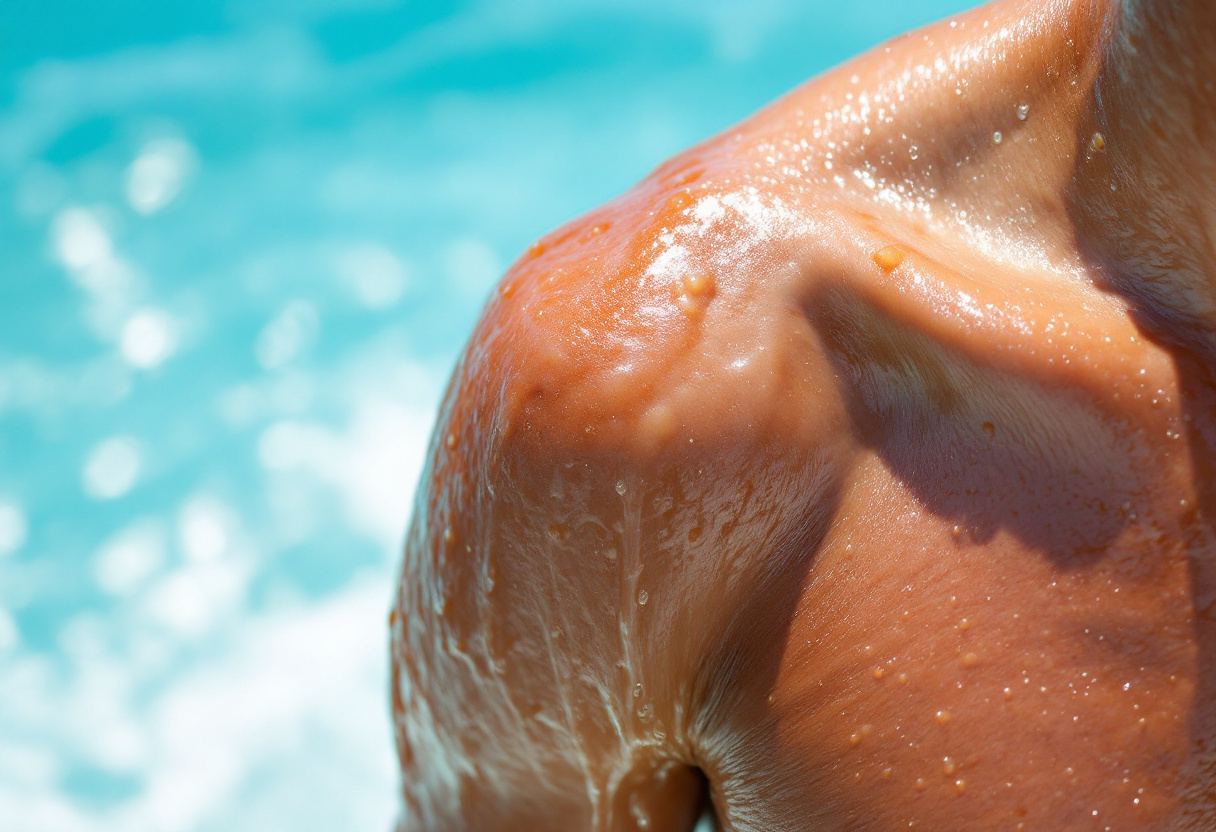
- Swimmers and surfers: shoulders, upper back, the back of the neck, the tops of the ears, the backs of the hands, and the band at a wetsuit neck seal.
- Sailors and paddlers: the backs of the hands, the forearms, the nose, the ears, the underside of the chin, the tops of the feet.
- Cyclists and runners: the forearms in a band ending at the sleeve, the back of the neck, the ears, the backs of the hands above a glove line, the tops of the thighs.
- Hill walkers and ski tourers: the face, the ears, the back of the neck, the parting, the backs of the hands, and on snow the underside of the nose and chin.
- Outdoor workers: all of the above, plus a likely left or right asymmetry if you consistently work facing one way.
Our note on the places everyone misses is the same list from the other direction: the sites hardest to protect are the sites that accumulate the most.
Making it routine
The practical obstacle is not knowledge, it is that checking your skin is an event people intend to have and never schedule. Three things that make it a routine instead:
Attach it to something that already happens
The end of a season. The clocks changing. A birthday. Any recurring date works better than an intention.
Ask someone to look at your back
You cannot see your own upper back or the back of your neck, and those are two of the highest exposure sites for most of the activities on this site. This is the single most useful part of the routine and the part most often skipped.
Take a photograph
Not to diagnose anything. To have a reference point, so that the question of whether something has changed can be answered rather than guessed at. Change over time is what matters, and memory is not reliable over months.
When to see a GP
The NHS sets out when to seek advice about a change to the skin, and its guidance is the right source. In general terms, anything that is new, that is changing, or that is not healing is worth an appointment.
We will add one observation, because it is behavioural rather than clinical and it is where a publication like this can help. The people most likely to delay are the people this site is written for: outdoor workers, sailors, surfers, hill walkers, anyone with weathered skin who has normalised the appearance of a lot of sun exposure. When everything about your skin looks weathered, a change is harder to notice and easier to dismiss. That is a reason to check deliberately rather than to rely on something announcing itself.
Making an appointment about something that turns out to be nothing is not a waste of anyone's time. It is what the appointment is for.
Sunburn itself
The NHS publishes guidance on what to do about sunburn, including when it needs medical attention. We are not going to reproduce it here, because the version you should read is the one that is maintained. Blistering, extensive burns, feeling unwell, and sunburn in a young child are all situations where advice should be sought rather than waited out.
What the pack can and cannot promise
Helps prevent skin cancer
What it certifies
On a United States pack, a claim tied to a specific regulatory position: the Food and Drug Administration permits a statement of this kind only for products meeting its broad spectrum and minimum factor requirements, and requires a warning on those that do not. It is a regulated claim in that market.
What it does not
In the UK and EU, sunscreen is a cosmetic product and claims are governed by the common criteria for cosmetic claims. Whatever the wording, no sunscreen prevents anything on its own: it works only in combination with shade, timing, clothing, adequate quantity and reapplication, and it is not a substitute for having a change to your skin looked at.
The wider point is that no product on any shelf in any country is a substitute for a look at your own skin. Sun protection reduces exposure. It does not monitor anything, and it does not report back.
If you are going to photograph something
A photograph is only useful if it can be compared with a later one, which puts some practical requirements on it. Take it in consistent light, ideally daylight rather than a bathroom bulb. Include something in frame that gives a sense of scale. Take it from a consistent distance. Note the date, which your phone does for you. And keep it somewhere you will find it again in six months.
None of this is diagnosis and we are not suggesting it substitutes for one. It answers a single, specific question that people otherwise answer from memory and answer badly: has this changed. That is a question worth being able to answer accurately when you are sitting in front of a GP.
Who else should be looking
You cannot see your own upper back, the back of your neck, the backs of your ears or your scalp. Those are, for most of the activities described on this site, among the highest exposure sites you have. A partner, a family member or a friend can look at them in thirty seconds.
Hairdressers and barbers see more scalps than anyone else, and people who work outdoors often have colleagues who see the back of their neck every day. It is entirely reasonable to ask someone to tell you if something on your scalp or neck looks different. The request is not strange, and the alternative is that nobody looks at those areas at all.
What this page will not do
We publish no skin cancer statistics, no incidence figures and no risk estimates. We do not describe the appearance of any lesion. We do not offer a checklist, a self assessment tool or a symptom guide, and we never will, because doing so responsibly is beyond what a field guide can do and doing it irresponsibly causes harm in both directions.
What we do is the part we are actually equipped for: describing the conditions, the mechanisms and the standards, so that fewer people acquire the exposure in the first place. Our editorial standards set out this boundary formally.
Where to go instead
- The NHS, for sun safety guidance and for when to see a GP.
- The British Association of Dermatologists, for public patient information leaflets.
- Cancer Research UK, for public information on sun, ultraviolet and cancer.
- Your GP, for anything about your own skin.